
Latest Blog
The North I-35 Growth Corridor: Where Buyers Are Moving in Greater San Antonio
The North I-35 Growth Corridor: Where Buyers Are Moving in Greater San Antonio If you have shopped for a home anywhere northeast of downtown San Antonio recently, you have already touched the North I-35 Corridor,

Why Buyers Are Choosing Stone Oak and North San Antonio
Why Buyers Are Choosing Stone Oak and North San Antonio Stone Oak has been one of San Antonio’s most in-demand districts for years, and in 2026 that demand shows no sign of slowing. Buyers coming

New Construction Homes in Stone Oak and North San Antonio
New Construction Homes in Stone Oak and North San Antonio Stone Oak itself has limited new inventory these days. After more than two decades of development, most of the district’s buildable land has already been
The North I-35 Growth Corridor: Where Buyers Are Moving in Greater San Antonio
If you have shopped for a home anywhere northeast of downtown San Antonio recently, you have already touched the North I-35 Corridor, even if nobody called it that. It is the stretch of communities strung along Interstate 35 and its feeder roads between San Antonio and New Braunfels, and it has quietly become one of the most active homebuying regions in the entire state. This guide is the big-picture view: what the corridor actually is, why so many buyers are landing here, and how to think about choosing a spot along it before you dive into any single community.
What the North I-35 Corridor Actually Covers
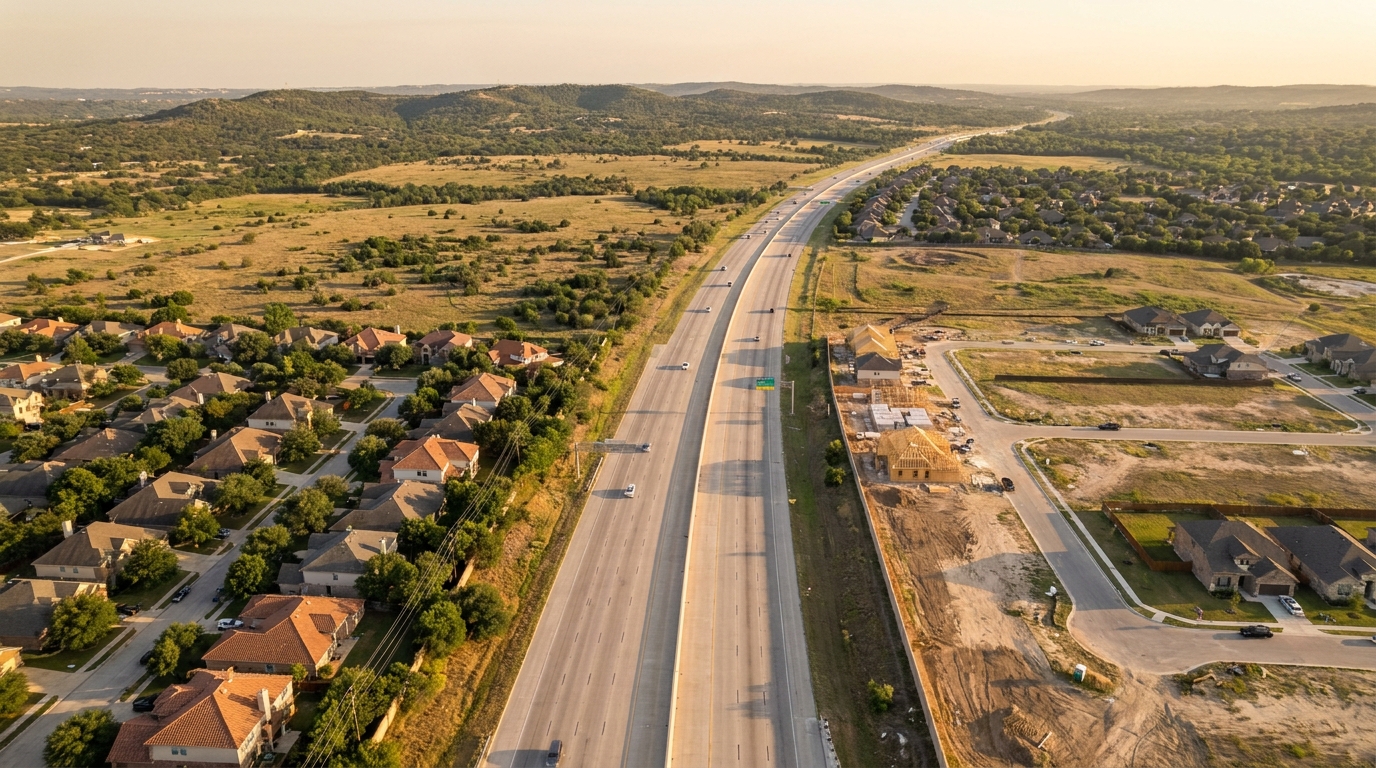
The corridor runs roughly from the northeast edge of San Antonio, through Selma, Schertz, Cibolo, Universal City, Converse, and Live Oak, up through Garden Ridge and into New Braunfels, spilling across parts of Bexar, Guadalupe, and Comal counties along the way. It is not one city or one school district, it is a connected string of communities that share a highway, a labor market, and increasingly, a single real estate story. Industry analysts tracking housing supply in this region now group Selma, Schertz, Universal City, and outlying Guadalupe County together with New Braunfels as one submarket, which tells you how tightly linked these communities have become in practice, even though each one keeps its own identity, schools, and city government.
Why This Corridor Is Growing So Fast
Three forces are converging here at once. The first is the broader Austin-San Antonio megaregion, one of the fastest-growing areas in the country, with the combined population of the two metros already near five million and projected to reach six to seven million by 2030. The North I-35 Corridor sits at the San Antonio end of that spine, which means it captures both San Antonio's own growth and a share of the overflow from a red-hot Austin market.
The second is jobs. Submarkets including Cibolo, Schertz, and New Braunfels are pulling in hundreds of millions of dollars in new industrial and logistics investment, anchored by projects like the roughly $450 million next-generation distribution center planned for the former San Antonio Raceway site in Cibolo, expected to bring more than 425 full-time jobs at above-median wages. Add in existing employers like the Amazon and Walmart distribution centers, Sysco Central Texas, and H-E-B's Schertz operations, and this corridor has become a real employment center in its own right, not just a bedroom community for downtown San Antonio.
The third is infrastructure. The Texas Department of Transportation's I-35 Northeast Expansion, a roughly $1.5 billion project, is widening about 20 miles of I-35 through Bexar, Comal, and Guadalupe counties, adding elevated express and HOV lanes in each direction. It is a long-term investment that signals the state expects this corridor's population and traffic to keep climbing for years, and it is already reshaping where builders choose to break ground.
A Corridor of Communities, Not One Market
Part of what makes this corridor interesting is that it is not a single, uniform suburb. Selma, Universal City, and Converse offer some of the most established, lower-priced entry points. Schertz and Cibolo anchor the middle of the corridor with a mix of resale and new construction and some of the strongest schools in the area. Garden Ridge and the areas approaching New Braunfels lean more toward larger lots and a Hill Country feel.
New Braunfels itself sits at the corridor's northern end, with its own thriving downtown, river tourism economy, and the fastest population growth of the group. Each of these has its own dedicated guide on our site, and our roundup of the best communities along the corridor is the fastest way to compare them side by side.
Who Is Actually Buying Along This Corridor
The corridor pulls a wide mix of buyers. Military families connect naturally to the northeast side given its proximity to Randolph Air Force Base and Joint Base San Antonio. Commuters working in San Antonio's medical center, downtown, or the northeast job hubs choose the corridor for the combination of newer housing stock and a manageable drive.
A growing number of Austin-area workers and remote employees have also discovered that the corridor offers meaningfully more home for the money than anything close to Austin, while still sitting within the same broader economic region. And increasingly, corporate relocations and logistics-sector employees are landing here directly, drawn by the same industrial investment that is reshaping the corridor's job base.
How to Think About Choosing a Spot Along the Corridor
The most useful way to approach this corridor is to decide what you are optimizing for first, then let that point you toward the right stretch. If price and new construction matter most, the communities toward the middle and northern end of the corridor, Cibolo, Garden Ridge, and the New Braunfels side, currently offer the deepest new-home pipeline.
If you want the shortest possible commute into San Antonio proper, Selma, Universal City, and Converse sit closest in. If schools are the top priority, Schertz-Cibolo-Universal City ISD and Comal ISD both carry strong regional reputations, though the exact assigned campus still depends on the specific address. And if lifestyle and weekend recreation matter as much as the home itself, New Braunfels and its rivers are hard to beat.