
Latest Blog
8355 Falcon Meadow | 4-Bedroom Rental in Converse, TX
8355 FALCON MDW, Converse, TX For Lease Description Photos Marketing Your Home Real Estate Reports for Home Owners, Sellers & Buyers! Maps & Local Schools More $ CLICK FOR CURRENT PRICE 4 BEDROOMS 3 BATHROOMS

Inside Saddle Creek Ranch: Davidson Homes’ New Community in Cibolo, TX
Saddle Creek Ranch Cibolo TX | Davidson Homes New Construction If you’re searching for new construction in Cibolo, Texas, there’s a new community worth putting on your radar: Saddle Creek Ranch by Davidson Homes. I
Why the North I-35 Corridor Is One of the Fastest-Growing Areas in Texas
Why the North I-35 Corridor Is One of the Fastest-Growing Areas in Texas Texas has no shortage of fast-growing suburbs, but the North I-35 Corridor between San Antonio and New Braunfels stands out even by
Why the North I-35 Corridor Is One of the Fastest-Growing Areas in Texas
Texas has no shortage of fast-growing suburbs, but the North I-35 Corridor between San Antonio and New Braunfels stands out even by the state's own high bar. The growth here is not a single hot subdivision or a short-term spike, it is a combination of population trends, job investment, and infrastructure spending all pointing the same direction at once. Here is what is actually behind the numbers.
Part of one of the fastest-growing megaregions in the country
The North I-35 Corridor sits at the southern end of the Austin-San Antonio megaregion, widely described as one of the fastest-growing regions in the United States. The two metros already carry a combined population of just under five million people, a figure projected to reach six to seven million by 2030 and potentially nine million by 2050. Texas state resolutions have formally recognized the Interstate 35 corridor between Austin and San Antonio as one of the fastest-growing regions in the country, and the North I-35 Corridor captures a meaningful share of that growth simply by sitting at San Antonio's end of the spine.
New Braunfels: a population growth story on its own
New Braunfels, anchoring the corridor's northern end, has become one of the standout growth stories in the entire country in its own right. The city's population recently climbed to nearly 111,000 residents, up almost 6 percent in a single year, and it has consistently ranked among the nation's fastest-growing cities. New Braunfels was also recently named among America's hottest zip codes for new movers, with analysts pointing specifically to households seeking newer homes, more space, and relative affordability while staying connected to major job markets in both San Antonio and Austin.
Hundreds of millions of dollars in new industrial investment
Population growth alone does not explain a corridor this active, jobs do. The stretch of I-35 north of San Antonio has become a focal point for large-scale industrial and commercial investment, with submarkets including Cibolo, Schertz, and New Braunfels attracting hundreds of millions of dollars in new development. The most striking example is a roughly $450 million next-generation robotic distribution center planned for the former San Antonio Raceway site in Cibolo, backed by a Fortune 500 company and expected to generate more than 425 full-time jobs at above-median regional wages. That kind of investment signals real corporate confidence in the corridor's long-term labor pool and logistics position, not just short-term speculation.
A $1.5 billion bet on the corridor's future
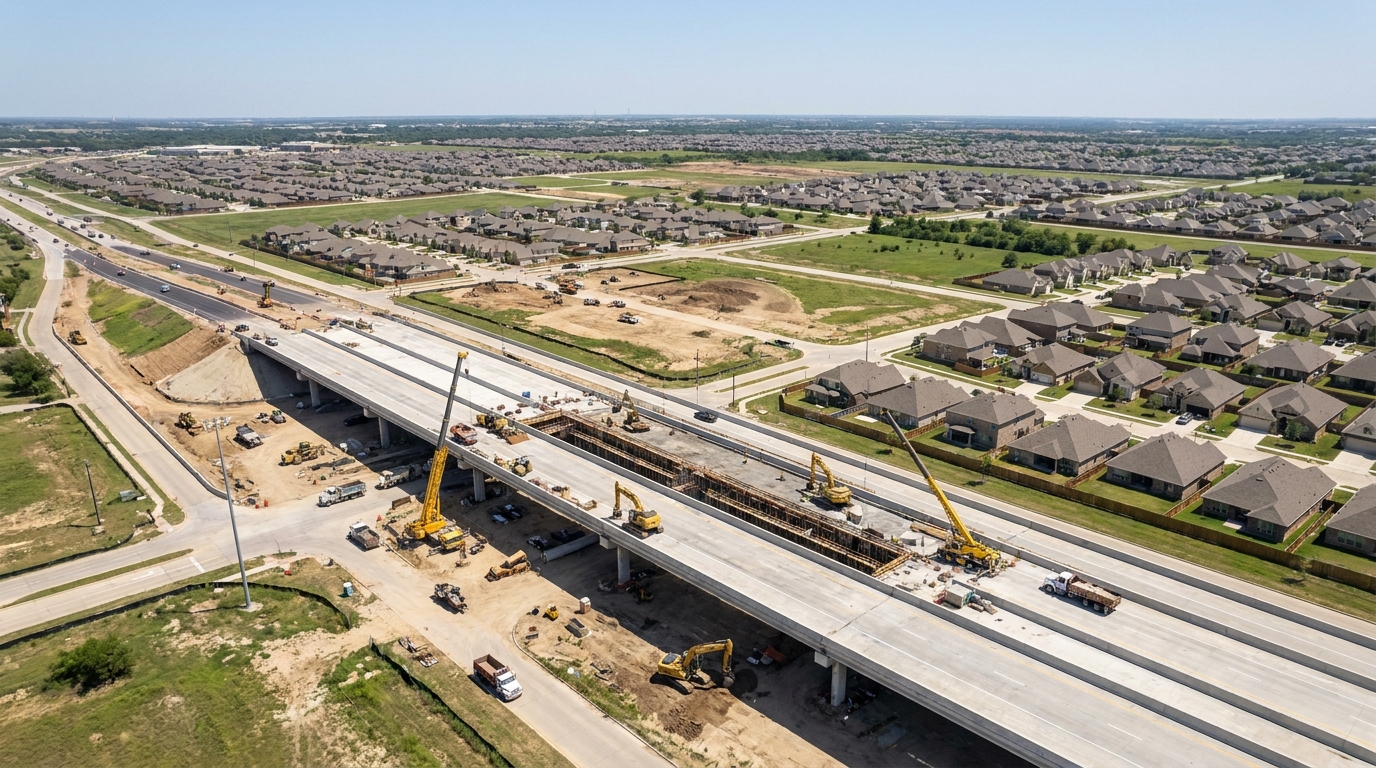
Infrastructure spending tends to follow population, and in this corridor it has arrived in a big way. The Texas Department of Transportation's I-35 Northeast Expansion is a roughly $1.5 billion project widening about 20 miles of I-35 through Bexar, Comal, and Guadalupe counties, adding elevated express and HOV lanes in each direction between downtown San Antonio and Schertz and beyond. A project of this scale is not built for today's traffic, it is built for where the state expects population and commuting demand to be a decade from now, and it is one of the clearest signals available that the corridor's growth is expected to continue rather than plateau.
A genuine affordability advantage inside a hot region
Much of the corridor's appeal comes down to simple math. Home prices across this stretch remain meaningfully below comparable communities near Austin, even as the corridor benefits from the same broader economic momentum. For buyers and employers alike, that combination, real affordability inside one of the country's fastest-growing megaregions, is difficult to find anywhere else in Texas, and it is a primary reason both population and industrial investment keep flowing into this corridor rather than slowing down.
What this means for buyers right now
None of these trends are new, but 2026 represents a meaningful moment in the corridor's growth curve: industrial investment is accelerating, the highway expansion is roughly midway through construction, and New Braunfels' growth rate continues to outpace most of the country. Buyers who get in now are positioning themselves ahead of infrastructure improvements that will meaningfully ease the corridor's current commute bottlenecks, and ahead of a job base that is actively expanding rather than simply riding San Antonio's coattails. For buyers who value getting ahead of a growth curve rather than paying a premium after it has already played out, this corridor remains one of the more compelling opportunities in the state.